

[IMPORTANT NOTE – Adobe stopped selling CS6 seven years ago – here’s why… So, CS products are no longer being made by the company, nor legitimately for sale through any channel in any country, from any vendor or reseller.]
Some folks think it might be a good idea to try to save a few bucks and buy Adobe software off of eBay, Craigslist, Amazon Marketplace, or from any vendor or seller who is unfamiliar. It could be Creative Cloud, CS6, Photoshop, Lightroom, Acrobat, Elements, or any other title – in a retail, student, full or upgrade version… or sometimes it’s the “OEM” scam, or the plausible-sounding “extra” volume license swindle, or an illegal black or “gray market” import.
But it’s actually not a very good idea at all. Why?

The first problem is that Adobe does not recognize these venues as valid or authorized resellers, they are fully disregarded and invalid. So as a result, Adobe will not officially recognize any of those buyers as actually owning their software.
Meaning, you think you own the genuine article but effectively you don’t. You cannot provide an accepted proof of purchase – so you can’t formally prove you own the products. You may not be able to transfer the software to someone else, nor be able to get product support or upgrade to the next version, etc… You also aren’t able to return the software to get your money back from Adobe like you normally can.
Why doesn’t Adobe recognize the people that go through those places? Doesn’t that seem unfair? Can’t these software vendors who you’ve never heard of before be trusted?
No, because in this area, reputation matters… a lot. The simple reason is – and the real problem is – that 90% of the software sold on places like eBay is counterfeit! Yes, it’s true. And it’s not a new problem.
And the buyer may not find out right away. Unfortunately, a serial number may be blocked or revoked at some point later when re-activating or reinstalling Adobe software in the future. And then it’s too late.
Adobe clearly states, “Purchasing from known and trusted sources is the best way to avoid risks. Avoid all online auction sites — they’re rife with counterfeiters. The only safe way to purchase genuine software for download is through the Adobe Store.” For their mainline product, Creative Cloud, the software itself is non-transferable, thus it is never validly sold on eBay. Further, there is no such thing as an “OEM” version of it.
So you can be pretty sure that what someone’s getting on those auction and vendor sites is not legitimate, not able to be legally transferred, and possibly even quite unsafe.

That last part is the real kicker. A great deal of the hacked and pirated Adobe software out there now is embedded with malware. These infections include viruses, worms, and trojans that can do significant harm to your computer, personal data, and privacy (like quietly stealing your sensitive information such as logins, passwords, and credit card numbers). Or increasingly, install ransomware to hold your entire hard disk hostage with no fix available.
Or put another way, you dramatically “increase your risk of exposure to viruses, spyware, or adware that can destroy (or, worse, publish to criminals) valuable data.” But unfortunately, many people don’t learn about this until it’s too late. Often they do this unknowingly – and are essentially paying someone to do it to them by buying the unauthorized software.
How prevalent is malware in unlawful software? Well, just one example: China reportedly has a piracy rate of 79% – and a corresponding computer infection rate of nearly 70% – both are the highest in the world. There is a direct correlation.
Yes, there can occasionally be exceptions – but there are many more headlines over the years: “Adobe Creative Suite Crack Harvests Zombie Computers” … “Malware Writers Target Would-Be Pirated Software Users” … “Rogue Adobe Product Downloads Infect Machines with Undetected Keylogger” … “Warning: The Pirate Bay currently has countless viruses disguised as downloads” … “Bootlegged Mac Photoshop Delivers New Trojan Horses” …
The second Trojan was discovered Sunday, hidden inside torrented copies of Adobe Systems’ Photoshop program. Once installed, the software silently lets someone else take remote control of the computer and rob the sensitive data upon it.
The risk seems obvious for older or used/secondhand copies, right? But even advertised “new in box” (NIB) items in seemingly-original packaging can easily be fake (see what the FBI says about this here) – and it’s often very difficult to tell the difference from the outside of the packaging, or even from the inside. As Adobe says, “… it can come with sophisticated-looking cases, manuals, and even registration cards. You’ll only discover software is pirated when you try to register it and can’t, often rendering the software unusable.” Or worse.
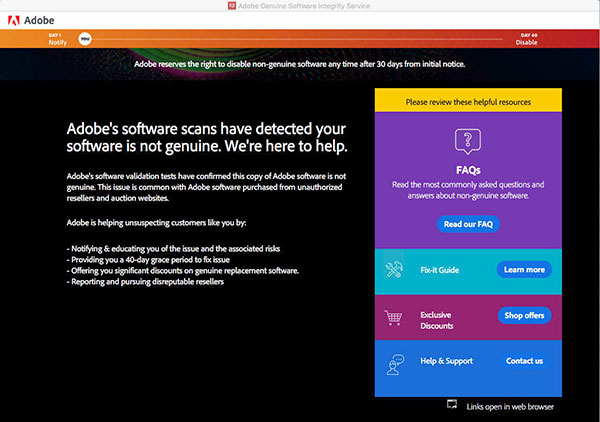
But even if the software within is authentic, it’s still breaking the law. Per the SIIA, “As this prosecution demonstrates, it is both a crime to create counterfeit software and a crime to sell authentic software without authorization.” So in any event, these buyers still face all the other issues above.
And if anyone ever offers a download or serial number that’s coming from anywhere else other than Adobe – it’s definitely not genuine, or legal. There are countless stolen, pirated, or limited-life serial keys out there, and even Adobe can’t tell right away. Even if a sale looks good at the beginning, such licenses are usually revoked down the road.
The old advice applies here: anything that sounds too good to be true probably is, in pricing or otherwise… (note that Adobe’s true Student & Teacher Editions at up to 70% off including the $20 complete Creative Cloud are exceptions to this)
So what’s your best bet?

The only safe and legal place to instantly download any of these products (either trial or full versions) is directly from Adobe’s servers.
And only safe and legal place to buy any boxed retail software is directly from Adobe itself, or through their officially authorized resellers or retailers.
They put all this in place to protect customers – not only from harmful or counterfeit software, but also protecting your rights as a legitimate buyer and recognized licensee of the products – fully able to receive customer service, technical support, important updates, and future upgrades.
See all the recommended tips on how to avoid Adobe piracy. And if the regular product prices are out of reach for you, see if you qualify for Adobe’s deeply-discounted education versions, or check out their affordable Creative Cloud offering with the latest-and-greatest 2024 release — which is guaranteed to be the genuine article.
See Also
- The 10 most common myths about Creative Cloud
- What are the differences between Adobe CC vs. CS6?
- Download free Adobe books (choose over 30 titles)
- How to save 60% with the Student & Teacher Editions
- Free Adobe Stock! Download 1,000,000+ top images
- Don’t need full Cloud? Get PS + LR for $9.99/month
Keep up with the latest on Adobe software — follow us on Facebook or Twitter, or subscribe to our RSS feed… You can also enter your email and have new articles sent directly to your Inbox. We are reader-supported; when you buy through links on our site, we may earn an affiliate commission.




I bought my CS5 Premium suite from the Indiana University bookstore back in 2012 (already had CS2 from several years before). I had to upgrade my desktop this month (march 2020) and magically I started getting the software is not legit error despite the fact that Adobe’s own server shows me as being the licensed user of the CS software. Adobe Customer Svc is great at telling you they’re really sorry for the inconvenience but there’s nothing they can do – plus they don’t return calls!
I had the same issue. Bought CS6 from a UK seller in 2016, i contacted Adobe support asking them to confirm that the license is legit which was the case, they sent me an email confirming the license is legit so i registered it in my adobe account since 2016.
This year my license was revoked, and i sent to adobe support the invoice of purchase and a copy of adobe’s mail confirming my license is genuine. they refuse to solve the problem and try to sell their subscription. Unfortunately, the only way to interact with these kind of people is justice courts.
Hello Nahnou,
This story is not uncommon. As detailed in the article above, there are several explanations for why this can happen… For example, scammers buy term-based licenses (e.g., genuine and valid but only for three months or one year) and sell them to unsuspecting customers as “permanent” – but then those licenses later expire. By then, the con man is long gone with your money.
What seller (and where) did you purchase the software or license from? Was it a vendor with a familiar and trusted name? It’s best/safest to buy only directly from Adobe or from a reputable source.
Yet another cautionary tale:
“The serial number you have entered has been revoked. This product cannot be licensed.”
March 16, 2020
Actually, Adobe doesn’t allow for some countries to purchase the product directly, but with a reseller – but the resellers only sell the adobe for small companies, not for individuals. So, Adobe is also part of the reason why people have to crack it. They fail to provide users worldwide a way to acquire their product in a legit way.
Not true. Creative Cloud is sold in 210 countries worldwide (essentially all of them)… In the countries with resellers, customers can simply purchase a single license. There is no restriction for companies only.
Even a Creative Cloud for Teams subscription can be purchased even for just one ordinary individual user, so it’s not necessary to have a business or group in order to get it.
INT: Ian’s House in London – Night
It is a cold November evening, a low wind is beginning to howl through a copse of woodland nearby.
There is a full moon and the last pops and crackles of the evening’s firework displays heave their last hurrahs.
The Camera tracks into the window and through into the sitting room as we discover Ian sitting thoughtfully by a warm open fire.
IAN V/O
“I am not dreaming this but I wanted to check if anyone else had had the entire Adobe Creative CloudSuite PRE-Loaded onto their newly bought Apple MacBook Pro in or around September 2009. It was a while ago I’ll admit and to be honest I didn’t think much of it at the time, I remember the Assistant at the Apple Store making it a sort of selling point which I thought curious because it was highly rumoured that Adobe were in a spot of bother and possibly throwing in the towel. The rest is history of course and it is well-known that Adobe didn’t sell the House just decided to rent it out instead. I am not dreaming this I promise you, and you must believe me if you are to bear witness to this tale, for I am undone, by cruel men insistent and relentless in pursuance of damning me, they will win and I will be their fool and I will fade away unless one of you comes forward, unless one of you takes that first step into this mystery with me……
CUE LIGHTHEARTED MUSIC AND MONTAGE
I went into full-time work and the Adobe Creative Suite was consigned to the mechanical hard drive untouched. There it remained for a decade, its clever ‘ElementTables’ designs hardly glanced at and the Activation codes which came with the purchase of the machine, and the ‘licence’ which was inside the Instruction Manual for the machine lay somewhere in the attic gathering dust and mosses from the occasional lifegiving drip, handed down from the benevolent Old Water Tank that fed the heating system way up and far away in that cold forbidden place known as The Attic.
Cut to this time last year and enter me, happy self-taught Final Cut Pro X Editor – “Still aways to go but getting there” – I remember I had just installed a new SSD into the now-getting-on-a-bit MacBook Pro and after performing my first ever Solo ‘Clean Install’ was feeling dazed but chuffed with myself, I became aware that Time Machine had tenderly and almost lovingly restored some vaguely familiar icons as if they were fragile eggs from her basket. On closer inspection (slow camera track to edge of basket and close up), a glow of Golden After Effects light spilled on to my wide-eyed, open-mouthed amazed face and, one by one, the eggs gently cracked apart and there they were, cooing and drooling and chewing on their tiny Adobe feet, reborn and free – yes FREE – my very own Adobe Family CS6 Creative Suite!
I held them close to me and never let them go and as I stared at them, blinking away tears of joy, through the Retina Screen of that Ol’ MacBook Pro, my heart pounded and I vowed out loud I would never leave them alone again, they would be given the best I had to give and they would live they would … Live (Choir begins slow climb to top C) White proton light beams sear through the glass of the Patio doors and Camera tracks up and out and up to the Full moon above and a twinkling nest of stars.
Fade to Black
Credits
NEXT WEEK ON “CUSTODY FOR CS6”
QUICK LIGHTNING FLASHES and Roars of thunder intercut with Vivid cuts of Management shaking their heads,
Emails of threatening LEGAL PROCEEDINGS, False Codes Numbers and Scams,
Shots of shadowy dealings in Taverns and places of ill-repute.
IAN TERRIFIED V/O
I was suddenly invaded by streams of Adobe Security Daemons rushing into my computer completely uninvited and had restarted the system, The Codes, The original Codes will not survive a restart! I was helpless, I was stopped from anything I was attempting to do with warnings that I had violated Adobe and she was seeking a death warrant to be enforced within the hour or something along those lines…… I swear!
Cue Lots of Slapping of Ian’s Face, Newspaper Headlines SCREAM Ian’s name, and his perverted Nighttime jaunts to Owl Sanctuaries
Will Adobe Win, Can Ian get a word of truth in edgeways
Same Time Same Channel, The After Effects of Being Alone With Adobe ( A NETflix Production from Primus Films Ltd)
Fade To Black
CREDITS
COMMERCIALS
Congrats Ian on the most creative comment we’ve ever received in over a decade of running this site! Really well done.
If there is a question in there, then we can only refer you to the “Adobe Genuine” website or their Customer Care for answers:
http://www.ContactAdobe.com/
Thanks again for an engaging read, and good luck with your films!
Thanks so much, I really appreciated your comments. I didn’t get a chance to read my little short film script until now, as I had assumed it had been lifted by the editor in case it had offended Adobe in some way. I’ve had a few of my literary insights pulled recently on a certain community websites by nervous moderators protecting and sanitising the debate, thereby pulling out the core and hiding the pips, thus denying any more comments or healthy arguments the chance to flourish or be harvested.
So glad this wasn’t the case in your esteemed publication.
Many thanks again,
Ian Francis
Creative Director
PRIMUS Films Ltd
UK
I have a mid-2011 Mac that runs High Sierra. It works fine and I have no reason to upgrade anytime soon. Adobe’s new Photoshop requires a newer OS but I can rent their unsupported older version (ver. 21.2.4) on CC. I’m thinking, it makes more sense to buy a used software package rather than pay rent to Adobe. I am not buying it for the “Support.” I just want a Photoshop and Illustrator package that is compatible with my OS system. Does that make sense?
Hey Kenneth, last year’s versions of the apps (the CC 2020 release) are actually still fully-supported by Adobe… See here for more info.
In a nutshell, Creative Cloud customers can always download and use the two most recent major versions of applications.
The only versions that weren’t subscription are the old CS releases, the prospects for which we’ve covered in the article and comments above.
After attempting to convert my project to a jpg file and not being able to find it on my computer and then unsuccessfully trying to update Camera Raw (which a number of users were told by Adobe was the problem), I’ll stick with Plan A, using CS6.
I just wanted to warn users that there is an eBay seller selling counterfeit copies, even though they at first appear genuine. They are even going as far as buying the software books to pair with the copied software.
The user sturbridge-lakes is selling multiple counterfeit copies of Adobe products. I asked the user through eBay messaging to provide a picture of the disc front and back which I will attach here that clearly shows the user is copying these CDs: the back of the disc is a blue/purple tint typical of a burnt CD, not the silver color of a genuine product. Also note the user is not providing original packaging.
Here is picture of back of disc that sturbridge-lakes is selling: https://i.imgur.com/HQWBAmE.jpg
Here is front: https://i.imgur.com/ZC2t8Ip.jpg
Here is original message: https://i.imgur.com/cNyYLIP.png
Here is image of recent Adobe sales showing user is selling multiple copies: https://i.imgur.com/UiPVLxk.png
With a seller-provided image showing a copied disc, it is safe to say that all Adobe products this vendor is selling are illegal copies, including Adobe Acrobat 9 Standard, Adobe Photoshop 6.0 and Adobe Photoshop CS4. Essentially everything they have listed here: https://www.ebay.com/sch/sturbridge-lakes/m.html?item=194171348816
As mentioned, this pirate is buying the user manuals to pair with his copies to make his items look legit. For example, you can see feedback left from bulldogunit on a recent sale of an Adobe Photoshop 6.0 manual that sturbridge-lakes would user to pair with his multiple copies of the software.
Welcome Tim,
Thank you so much for your detailed comment, and for warning the community – much appreciated!
It’s a shame; nothing on eBay has really changed over the years… Buyer beware.
…and here’s yet another story of someone buying a fake/pirated “full” version of Creative Suite and later having it flagged as counterfeit software by Adobe:
Adobe CS5.5 Standard jammed up after a year of use
This customer will never get their money back, and is fortunate (regarding their computer) if that’s the worst that happened.
But surely ADOBE could provide software in older versions while stating that it is UNSUPPORTED? I have an old Mac that cannot be updated to a newer OS. I’d be happy with Photoshop CS6. I just want to edit images in the familiar Photoshop environment.
Adobe are not only throwing money away by refusing to market old unsupported versions but they ARE forcing people to resort to risking a pirate/shonky version. People are left with no other choice.
No company is going to actively promote or sell old versions of software that they don’t support… Besides possibly being illegal, it’s not a good look. Never really heard of that anywhere, by any reputable software company.
That said, Adobe is not going to forcibly kick you off using older versions, if that’s all your system can run. They have never done that.
So all Creative Cloud subscribers can (unofficially) use older versions, going all the way back to CS6 in 2012… Those prior releases will still run under your paid membership.
So you don’t necessarily have to use the newest releases, if you prefer not to – or if your computer does not support the latest versions, due to their system requirements.
Just be aware that Adobe will “officially” support only the current release – CC 2022 – and one version back – CC 2021… But as long as you don’t run into any unexpected issues, then that shouldn’t be a problem, and you can continue to use previous versions as long as you want with your current subscription plan.
Again, this is pretty much undocumented and unpromoted, but there it is.
And still yet another scam story:
This is unfortunately common if you don’t buy from a reputable source or a vendor with a familiar/trusted name… Scammers buy term-based licenses (e.g., valid for three months or one year) and sell them to unsuspecting people as “permanent” – but then those licenses later expire. By then, the scammer is long gone with your money.
Please be aware that there is no such thing as a perpetual or permanent license for any Creative Cloud product. They are subscription-only, and no significant discounts from Adobe’s own prices are ever legitimately given. If Adobe is currently running a special promotion, then you will find it here.
I bought this Adobe Photoshop Elements on E-Bay and looking at the package, it has the Adobe logo on the box, plus everything looks genuine. it has three booklets and two discs. I have not yet tried to download as I am a little worried now after reading all the things that could go wrong with my computer. Do or don’t I download this elements 11 ?? Thanks for your reply to my email. Lizzie
We can’t make that decision for you, as even counterfeit discs can look quite real…
You might consider downloading and installing via the Adobe Direct Download Links and then entering the serial number from package. It still might not work (there are plenty of invalid license keys out there), but it would be safer than installing from discs of uncertain origin.
Does ANYTHING act/work like (much less open) PNG files in layers like Fireworks did?? NO, I didn’t think so.
There ought to be SOME way to get CS6 or Fireworks alone. What about these trial version links you have on this site?
Adobe no longer sells perpetual Creative Suite software.
However, current subscribers to Creative Cloud can use earlier versions of the tools if you wish, going back to CS6 – Adobe won’t force you to upgrade and there is no extra charge.
In other words, you should be able to get and use Fireworks CS6 on a subscription basis, rather than a perpetual license.
You just sign in to the software as normal and the older release will be automatically validated and activated. In other words, CS6 is not a trial version for paid Creative Cloud members.
So after the free trial is over, you can select which plan you want here:
http://www.ChooseCreativeCloud.com/
Fireworks would come with the ‘All Apps’ plan.